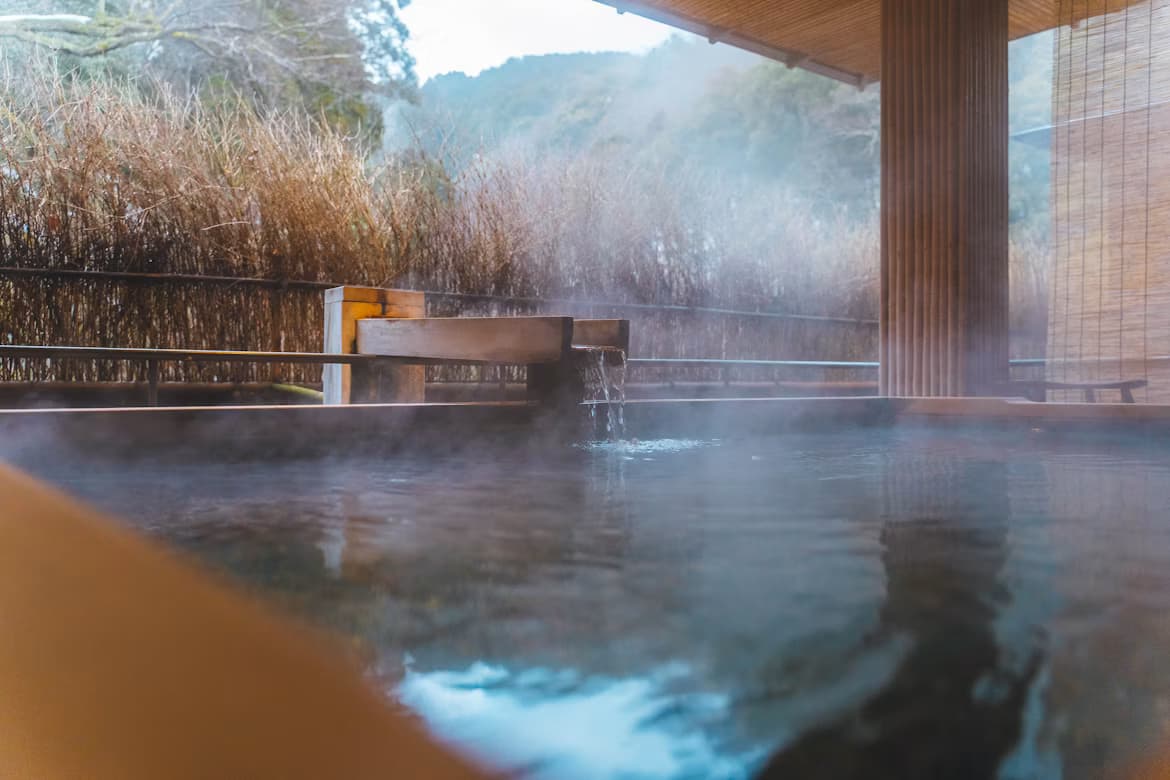
Nobody told me that some of Japan's best hot spring experiences were free. I only found out by accident.
We were in Nozawa Onsen on our November 2025 trip, the one where we flew into Fukuoka and eventually made our way through Kyushu, Hiroshima, Osaka, and then up to Aomori before looping back through Hanamaki and Sendai. By the time we reached Nozawa we had already paid entry fees at a dozen different onsen facilities across the country. Good ones. Worth every yen.
Then someone pointed out the small wooden building at the end of the lane and said it was open and free. I walked in, paid nothing, and had one of the best soaks of the entire trip.
That started a habit. I began looking up which facilities charged nothing and which did not. What I found surprised me. Some of Japan's most unusual, most historically significant, and most memorable onsen experiences cost absolutely nothing to enter.
Here are nine of them.
Nozawa Onsen: 13 community bathhouses, all free
Nozawa Onsen in Nagano Prefecture operates thirteen public bathhouses called soto-yu, maintained by neighbourhood cooperatives that have been running them for nearly four centuries. Every single one is free.
The village treats the baths as a community resource, not a commercial product. You walk in, take off your shoes, soak, and leave. The locals use them daily. As a visitor, you are simply welcome to join.
The most famous is Oyu, the large wooden bathhouse at the centre of the village. The water runs very hot, sometimes above 50 degrees Celsius, and the etiquette is to mix it yourself using the long wooden paddles near the entrance. Do this correctly and the locals will nod approvingly. Do it wrong and they will very politely show you how.
We came back three evenings in a row. Not because we had to. Because it was that good.
Kusatsu Onsen: the public baths are free
Kusatsu is one of Japan's most famous onsen towns and its public bathhouses are free of charge. You pay nothing to use Netsunoyu, where the twice-daily yumomi cooling ritual takes place, or to soak in the neighbourhood baths scattered through the town.
The main bathing complex where the yumomi performance happens does charge for the performance viewing itself. But the baths beside the Yubatake thermal field, the hot spring source at the centre of town, are free and open all day.
Kusatsu is not a cheap town to stay in. But the bathing itself, the whole point of the place, costs nothing.
Yubara Onsen: the Sunayu is free, 24 hours
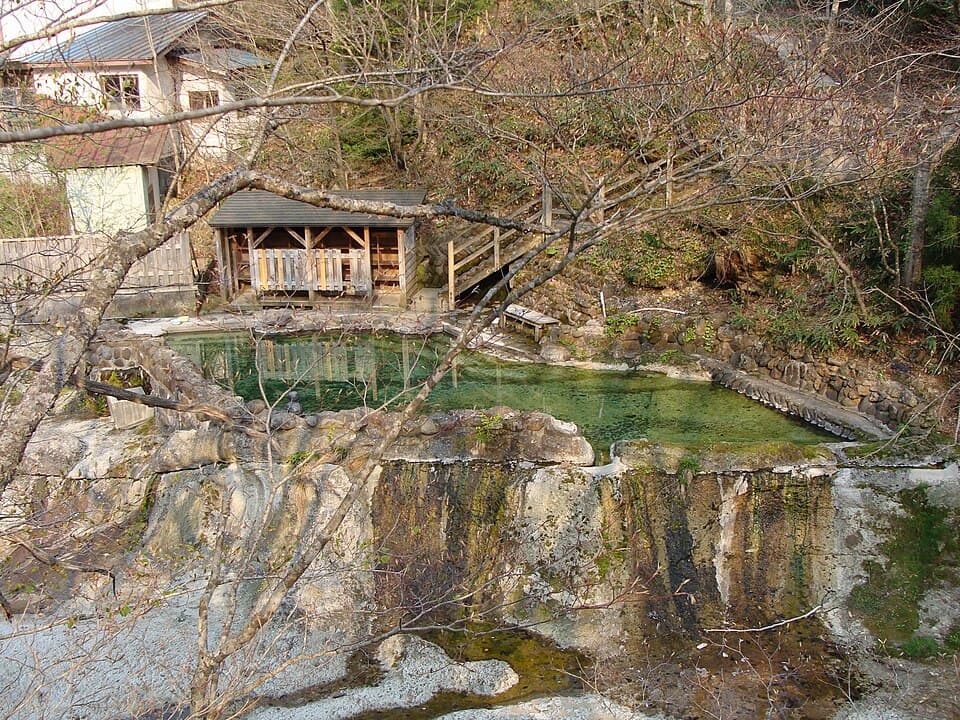
This one genuinely surprised me. Yubara Onsen in Okayama Prefecture sits above the Yubara Dam, and at the base of that dam, hot water bubbles up naturally through the sandy riverbed. The local authorities have simply left it there and opened it to anyone who wants to soak.
The Sunayu is outdoor, completely open to the sky, and operates twenty-four hours a day with no admission fee. You walk down from the main street, change in the basic facilities nearby, and lower yourself into water that the earth is providing for free.
There is something about it that feels different from a managed bathhouse. The water is just there, doing what it has done for centuries, and you are joining it for a while.
Kappa-no-yu Hot Spring: deep in Yagen Valley
Deep in the Shimokita Peninsula of Aomori, which we reached during our week staying in Aomori prefecture using our JR pass to explore the more remote spots, there is a free outdoor bath set in old-growth beech and cypress forest.
Ganso Kappa-no-Yu is named after the kappa, a water sprite from Japanese folklore said to have healed an injured Buddhist monk in these very waters around 862 AD. The spring produces a gentle, weakly alkaline water at 46 degrees. There are no walls. Just a roof, forest, a clear mountain stream running alongside, and you.
No soap or shampoo is permitted. The surrounding ecosystem is the point, and the rules protect it.
Open April through November only. Worth planning your Aomori itinerary around.
Tsubame Onsen: two free community baths at 1,100 metres
Tsubame Onsen sits at 1,100 metres on the slopes of Mount Myoko in Niigata Prefecture. The community has maintained two open-air baths since 1875, Ogon-no-Yu and Kawara-no-Yu, and both are free.
The milky-white sulfurous water earned the name triple beauty bath for its effects on skin. The Sotaki waterfall, listed among Japan's Top 100 waterfalls, is a short walk from the baths.
The road closes in winter. The season runs late April through November.
Noboribetsu Jigokudani: the walking path is free
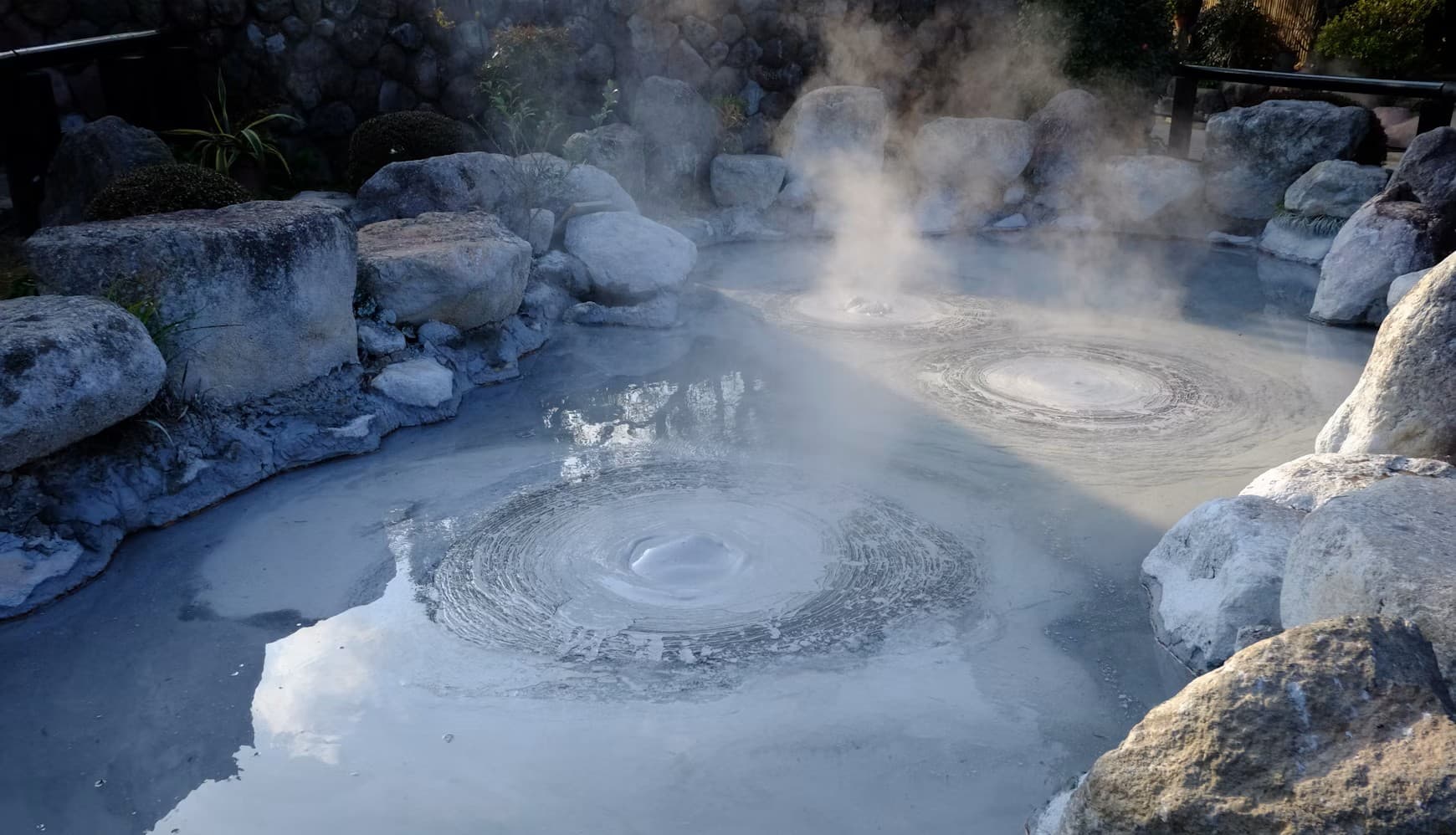
Noboribetsu's Hell Valley is free to walk through. The twenty-minute circuit through the volcanic crater, past boiling mud pools and sulfurous steam vents, costs nothing. You do not need to enter any of the paid bathhouses to experience the landscape.
The baths themselves, at facilities like Dai-ichi Takimotokan, do charge for entry. But the dramatic volcanic scenery that makes Noboribetsu what it is, the ochre-stained ground, the audible bubbling, the sulfur smell that becomes strangely satisfying within minutes, that is available to everyone.
Kawayu Onsen: seasonal riverbed bath in Hokkaido
In Hokkaido's Akan-Mashu National Park, the Io River is geothermally heated along its entire course. From late October to late February, sections of the riverbed are dug out to form the Sennin-buro, a communal outdoor bath that can hold dozens of people, sitting directly in the river, surrounded by steam.
It is seasonal, requires traveling to a fairly remote part of eastern Hokkaido, and is completely free. We reached it during our Aomori week on a day trip across the prefecture. It is the kind of experience that requires actual effort to find, which makes it feel even more worthwhile when you get there.
Higashi Onsen: remote volcanic island, free and open 24 hours
Higashi Onsen is on Iojima, a remote volcanic island in Kagoshima Prefecture reachable only by ferry from Kagoshima Port three times a week. The crossing takes nearly four hours.
On the island, there are three open-air baths set directly on the volcanic shoreline. Free. Open twenty-four hours. The water is strongly acidic and takes on a striking green color from the minerals. Volcanic steam drifts overhead. There are sea turtles in the surrounding waters and wild peacocks on the island.
This one takes genuine commitment. But if you make the ferry trip, you will have something very few visitors to Japan will ever see.
Onneto Hot Falls: viewing only, but extraordinary
The Onneto Yunotaki waterfall in Hokkaido's Akan Mashu National Park is not a bathing spot. Bathing was prohibited in 1989 to protect colonies of rare manganese-producing microorganisms that coat the rocks, the only location on Earth where this process can be observed above ground. In 2000 the falls were designated a Japanese Natural Monument.
You cannot soak here. But you can walk the twenty-minute forest trail from Lake Onneto and stand at the base of a geothermal waterfall with extraordinary black and orange mineral formations, in a UNESCO-adjacent wilderness, for free.
It belongs in any list of free hot spring experiences in Japan even if the bathing itself is prohibited. Some things are worth seeing without getting in.
---
Japan has hundreds of paid onsen facilities and most of them are excellent. But if your budget is tight, or if you simply want the experience of finding something that is just there for anyone who shows up, these nine are a very good place to start.
The SpringsAtlas listings for each of these include opening hours, access directions, and details on what to expect. The free entry filter in the search page shows all of them at once.