No photo available
Public · Indoor & Outdoor · ¥1,500
3.4· 21 reviewsvia Google
42–80°CWater temp
8.4pH
¥1,500 (~$10)Entry fee
PublicBathing type
—Opening hours
About this spring
One of the oldest and most historically significant springs in the Hakone caldera, set on a plateau in the Haya River valley. Miyanoshita is one of the Seven Hot Springs of Hakone and has been a destination for domestic and foreign visitors since the Edo period. The Fujiya Hotel, opened here in 1878, was one of Japan's first Western-style resort hotels.
Data: Wikipedia (CC BY-SA 4.0) · OpenStreetMap (ODbL)
Highlights
- Seven Hot Springs of Hakone
- Fujiya Hotel since 1878
- Emperor Meiji visited 1873
- Haya River valley plateau
Suitability
Tattoo policy
Not permitted
Children policy
Family-friendly
Altitude
420m
Mineral chemistry
Sodium Chloride (Salt)
Benefits
Sodium chloride springs — essentially natural saltwater baths — are celebrated for their warming and moisturising effects. The salt forms a thin film on the skin after bathing that slows moisture evaporation, keeping skin hydrated longer than a freshwater bath. This "heat-retaining" property means bathers stay warm for significantly longer after leaving the water, making these springs especially popular in winter. Salt springs are among the most accessible for first-time onsen visitors.
Note
Those with high blood pressure or heart conditions should consult a doctor before bathing, as the warming effect increases circulation. Avoid immersing open wounds. The salt will sting slightly in eyes — take care when submerging.
History
These springs have been used since at least the beginning of the Edo period.
Emperor Meiji visited in 1873 during his tour of Japan. The Fujiya Hotel, established in 1878, became a landmark of Meiji-era international tourism and hosted writers, diplomats, and foreign dignitaries. It remains open today as one of Japan's oldest resort hotels.
Local guide
From Shinjuku you take the Odakyu Romance Car, and within about ninety minutes the suburbs give way to the folded green hills of Hakone. At Hakone-Yumoto you switch to the Hakone Tozan Railway, a narrow-gauge line that winds uphill through tight switchbacks past small waterfalls and cedar forest so dense it blocks out the sky. Miyanoshita Station is three stops up, perched in the valley of the Haya River, and when you step onto the platform you immediately notice the old wooden tram shelter, the carved stone bridges, and the faint smell of warm stone carried on the river air. This is the oldest developed hot spring village in Hakone, and it does not look like it is trying to pretend otherwise.
The water at Miyanoshita is a sodium chloride spring with a pH of 8.4, putting it comfortably on the alkaline side. It runs clear and has very little scent. What it does have is that particular slippery quality that alkaline water develops against skin, leaving you feeling smooth and lightly coated for hours after you step out of the bath. The temperature flows consistently warm without the violent heat of some of Hakone's sulfur springs further up the mountain. It is the kind of water you can sit in for a long time without urgency, which suits Miyanoshita's overall pace perfectly.
The Fujiya Hotel, which has been standing at the center of the village since 1878, is impossible to miss and impossible to ignore. Its facade is a layered confection of Meiji-era ambition, mixing traditional Japanese rooflines with Western balconies and ornate wooden railings painted pale green. It opened to serve foreign visitors who began arriving in Japan after the ports opened, and its guest list from the following century reads like someone assembled it as a joke: Albert Einstein, Charlie Chaplin, John Lennon and Yoko Ono, and in 1893, Archduke Franz Ferdinand of Austria, four years before a bullet in Sarajevo changed everything. The main building and several wings are now designated important cultural assets. You can tour the lobby and the old flower-patterned dining room even if you are not staying.
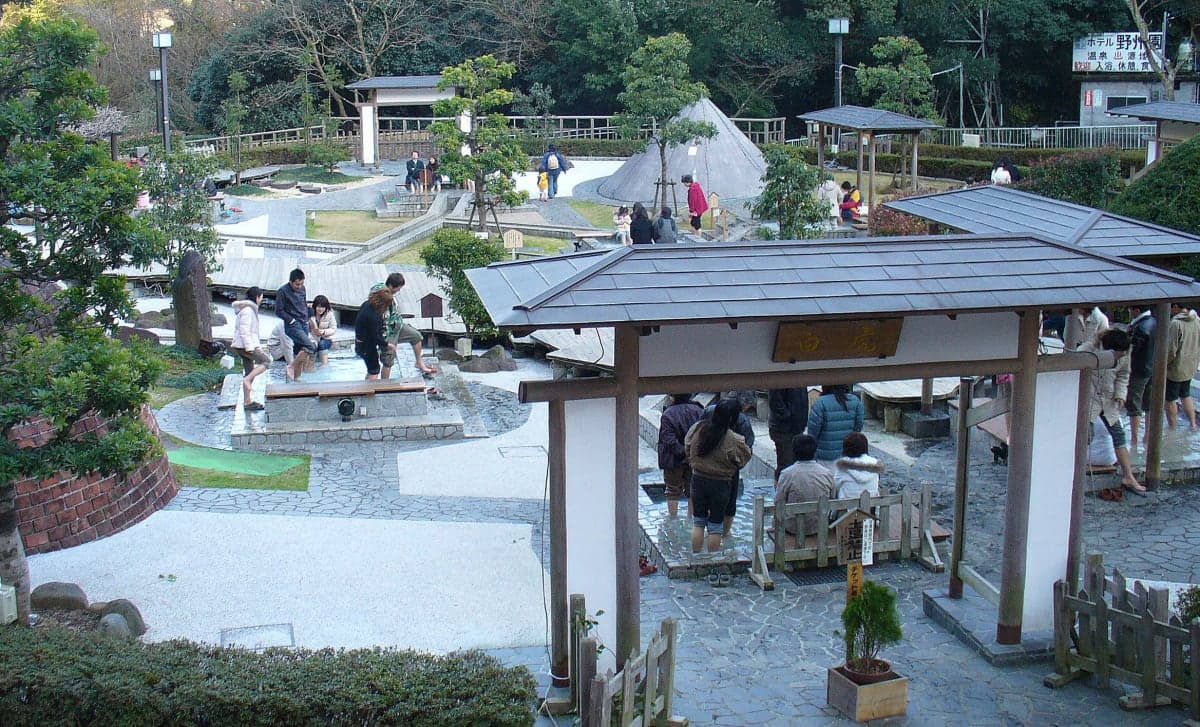
What makes Miyanoshita worth the trip is precisely this layering of time. It sits between two eras without fully belonging to either, and it wears that honestly. The public footbaths along the main street are free and busy in the evenings with exhausted hikers coming down from the Daikanzan ridge above the village. The small grocery below the station sells bottles of the local spring water. Jozen-ji temple is a five-minute walk up the hillside. And the tram, still running its improbable switchback route up the mountain, pulls in every thirty minutes with its bell clanging, as though Hakone in 1910 and Hakone today are the same place separated only by glass.
How this spring compares
pH level
8.4
More alkaline than79% of Japan springs
More acidic than18% of Japan springs
Japan median7.3
Japan range1.2–11.3
n=121 springs
Max temperature
80°C
Hotter than73% of Japan springs
Japan median60°C
Japan hottest105°C
n=122 springs
Getting there
Take the Odakyu Line from Shinjuku to Hakone-Yumoto Station. The journey takes about 80 minutes. From Hakone-Yumoto, take the Hakone Tozan Railway to Miyanoshita Station, about 15 minutes further.
Amenities
Towel rental
Locker
Restaurant
Café
Parking
Wheelchair access
English spoken
Tattoo-friendly
Private bath
Soap provided
Hair dryer
Location & nearby
Miyanoshita, 箱根町 Hakone, Ashigarashimo District, Kanagawa 250-0404
Odawara Station · 8.9 kmShinkansen
Miyanoshita Station · 0.4 km
Chōkokunomori Station · 0.8 km
Kowakidani Station · 0.7 km
Tokyo Haneda Airport · 73.6 km
Shizuoka Airport · 93.6 km
箱根園ヘリポート · 3.8 km
Hotel-mae · 0.1 km
Hotel Zen Bus Stop · 0.1 km
Hoterimae (Bus Stop) · 0.1 km
Book a stay nearby
Hotels near Hakone
72+ optionsSpringsAtlas may earn a commission from bookings made through these links.
More springs in Greater Tokyo
1 / 6


Last verified:
Data: OpenStreetMap (ODbL) · local tourism agencies
Unverified listing