
Public · Outdoor · ¥300
4.3· 2,000 reviewsvia Google
42–85°CWater temp
7.4pH
¥300 (~$2)Entry fee
PublicBathing type
—Opening hours
About this spring
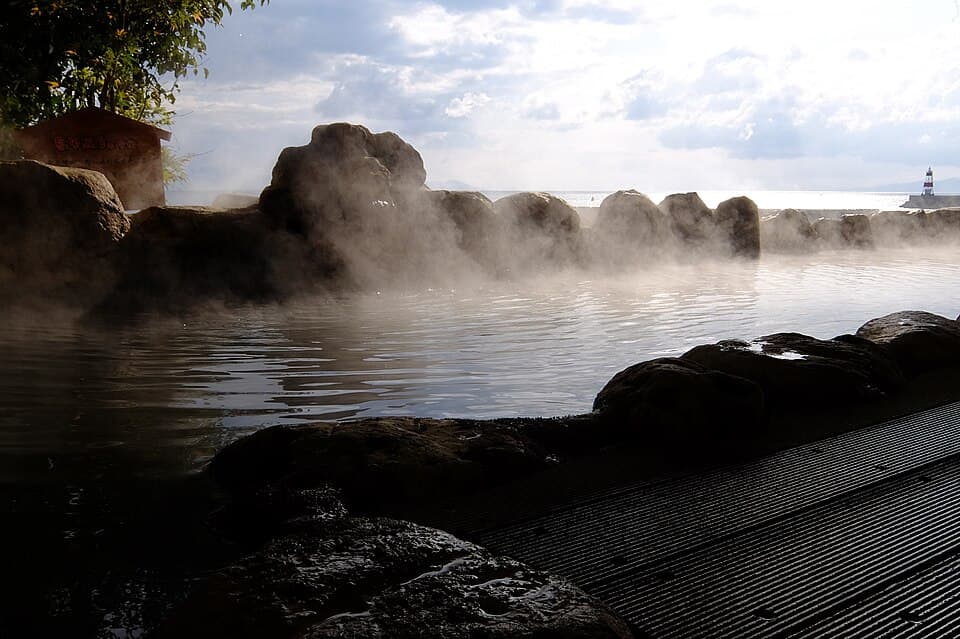
A subtropical coastal city at the southern tip of Kyushu, famous for natural sand baths where bathers are buried in geothermally heated black sand. The beach sits below Mt. Kaimon, an almost perfectly conical volcano. Attendants in yukata lead you to your spot, lay you down in the warm sand, and leave you to stare up at the sky.
Data: Wikipedia (CC BY-SA 4.0) · OpenStreetMap (ODbL)
Highlights
- Natural sand baths sunamushi
- Subtropical coastal setting
- Mt. Kaimon views
- Rare geothermal experience
Suitability
Tattoo policy
Policy varies
Children policy
Family-friendly
Altitude
5m
Mineral chemistry
Sodium Chloride (Salt)
Benefits
Sodium chloride springs — essentially natural saltwater baths — are celebrated for their warming and moisturising effects. The salt forms a thin film on the skin after bathing that slows moisture evaporation, keeping skin hydrated longer than a freshwater bath. This "heat-retaining" property means bathers stay warm for significantly longer after leaving the water, making these springs especially popular in winter. Salt springs are among the most accessible for first-time onsen visitors.
Note
Those with high blood pressure or heart conditions should consult a doctor before bathing, as the warming effect increases circulation. Avoid immersing open wounds. The salt will sting slightly in eyes — take care when submerging.
Simple Thermal
Benefits
Simple thermal springs (単純温泉) have a lower dissolved mineral content than other spring types but are valued for the pure therapeutic effect of heat immersion itself. The warmth increases core body temperature, promotes sweating, eases muscle tension, and improves peripheral circulation. Simple thermal springs are the most common onsen type in Japan and are recommended as the gentlest introduction to onsen bathing — suitable for a wide range of health conditions and ages.
Note
Simple thermal springs are the most broadly accessible onsen type. Standard precautions apply: avoid bathing within 30 minutes of eating, keep soaks to 10–15 minutes for first-timers, and hydrate before and after.
History
The sand bath practice began around 1703 when local residents discovered that the geothermally heated beach sand could warm the body as effectively as water.
A geography book of Kagoshima compiled in 1843 recorded its therapeutic use in detail: effective against rheumatism, respiratory ailments, anaemia, and diabetes. The Shimazu clan, who governed Satsuma for centuries, were patrons of the area's springs. Saigo Takamori, the most celebrated figure of the Meiji Restoration, was a devoted visitor to nearby Unagi Onsen. The Hakusuikan hotel expanded in the Meiji era to include Japan's first Western-style hotel rooms specifically designed for foreign health visitors. Today Ibusuki remains one of the world's rarest bathing experiences.
Local guide
From Kagoshima-Chuo Station, the Ibusuki-no-Tamatebako limited express takes just under an hour down the Satsuma Peninsula's eastern coast, and for the last stretch you are riding with Kinko Bay on one side and, if the weather is clear, the near-perfect cone of Mount Kaimon rising to 924 meters in the distance. Locals call it the Satsuma Fuji, and seeing it from a moving train window, symmetrical and slightly volcanic in feeling, does prepare you for the strange earth energy waiting at the end of the line.
Ibusuki is the only place in Japan, and one of very few places anywhere, where you can be buried alive in sand heated entirely by geothermal steam from below. This is not a gimmick. People have been doing it here for over three hundred years. The most popular facility is Saraku, a large sand bath hall located along the waterfront a short walk or five-minute bus ride from Ibusuki Station. You are handed a light cotton yukata before you go outside, where staff members are waiting with long-handled shovels. You choose a spot, lie down facing the bay, and watch the attendant pile black volcanic sand over your legs, torso, and chest until only your head sticks out above the surface.
The sand presses down on you at a temperature of roughly fifty to fifty-five degrees Celsius, which is warmer than a standard bath and yet somehow manageable because it is distributed evenly across your whole body. You begin sweating almost immediately. The fifteen minutes you stay buried feel much shorter than that. When you stand and brush off, the residual heat stays in your muscles for a long time, a different quality of warmth from a conventional soak, more like something absorbed from outside in rather than applied to the surface.
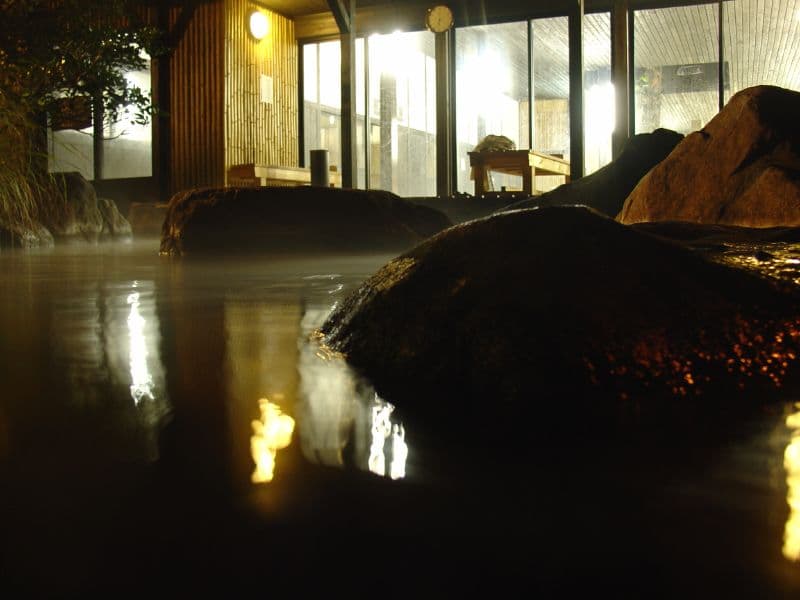
After the sand, you move inside to rinse in a conventional hot spring bath fed by the same geothermal source. The water here is a clear sodium-chloride spring at neutral pH, warm and faintly saline on the tongue, leaving a light mineral film on the skin. The real highlight is not the bath, though. It is the moment you step out of the sand, still in your damp yukata, salt sweat drying on your face, and look across the low beach toward that conical mountain on the horizon. It is a very specific picture, the kind that stays with you longer than a hot soak.
How this spring compares
pH level
7.4
More alkaline than53% of Japan springs
More acidic than44% of Japan springs
Japan median7.3
Japan range1.2–11.3
n=121 springs
Max temperature
85°C
Hotter than80% of Japan springs
Japan median60°C
Japan hottest105°C
n=122 springs
Getting there
JR Ibusuki-no-Tamatebako→ Ibusuki50 min
Walk to bathhouse
Total: 55 min
Take the JR Ibusuki-no-Tamatebako limited express from Kagoshima-Chuo to Ibusuki Station. The journey takes about 50 minutes.
Amenities
Towel rental
Locker
Restaurant
Café
Parking
Wheelchair access
English spoken
Tattoo-friendly
Private bath
Soap provided
Hair dryer
Location & nearby
Ibusuki City, Kagoshima 891-0404
Kagoshima-Chuo Station · 40.9 kmShinkansen
Yamakawa Station · 3.1 km
Nigatsuden Station · 3 km
Ibusuki Station · 0.8 km
湯の浜(下り) · 0.2 km
Kagoshima International Airport · 63.7 km
Miyazaki Airport · 104.2 km
Kokuritsu Ibusukibyoin Helipad · 1.6 km
Izumozakaimae (Kamari) Station · 0 km
Yunohama (Descending) Station · 0.2 km
Shiokushige-mae (Bus Stop) (Kagoshima Airport Line - Downhill) · 0 km
Yunohama (Upbound) Station · 0.2 km
Sakai (Descending) Station · 0.3 km
Izushi Ekimae (Descending) Station · 0.1 km
Book a stay nearby
Hotels near Ibusuki
23+ optionsSpringsAtlas may earn a commission from bookings made through these links.
More springs in Kyushu
1 / 13


Last verified:
Data: OpenStreetMap (ODbL) · local tourism agencies
Verified listing