
Public · Outdoor · Free
Kappa-no-yu Hot Spring
元祖かっぱの湯
46°CPublic BathOutdoorsimple-alkalineFree entry
4.2· 227 reviewsvia Google
46–46°CWater temp
8.0pH
FreeEntry fee
PublicBathing type
—Opening hours
About this spring
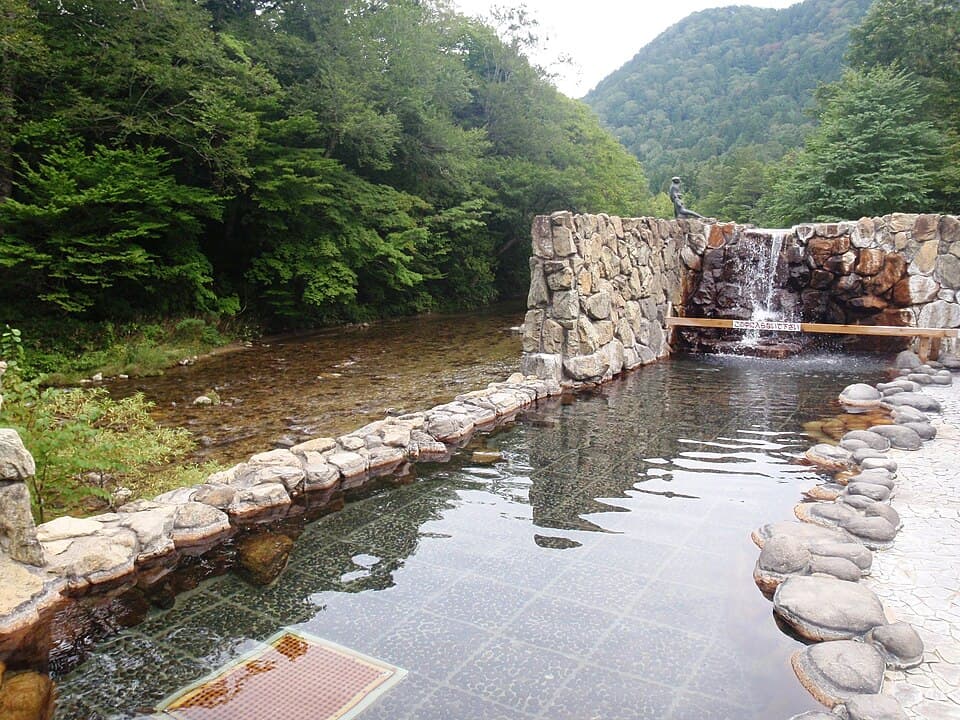
A free open-air bath set deep in Yagen Valley on the Shimokita Peninsula of Aomori Prefecture, about 2 kilometers uphill from the main Yagen Onsen area. Two baths sit alongside a clear mountain stream in old-growth beech and cypress forest. The water flows at 46 degrees Celsius. No soap or shampoo is permitted. Open from April through November, and free to use.
Data: Wikipedia (CC BY-SA 4.0) · OpenStreetMap (ODbL)
Highlights
- Free admission year-round
- Old-growth beech forest
- Kappa sprite folklore
- No soap bathing
- April to November
Suitability
Tattoo policy
Welcome
Children policy
Family-friendly
Altitude
200m
History
The spring is linked to the founding legend of 1615, when a warrior who fled north after the defeat at the siege of Osaka Castle discovered Yagen valley.
An older story connects the upper springs to the monk Jikaku Daishi, who around 862 AD is said to have been healed by a kappa water sprite who brought him to soak in the spring. The outdoor baths named Ganso Kappa-no-Yu and Fufu Kappa-no-Yu still sit at that spot. The name Yagen comes from the pestle-shaped mortar used in traditional herbal medicine: the V-shaped valley was said to resemble one.
Local guide
There is no public transport to Yagen Valley. That fact alone tells you what kind of place this is. You rent a car in Mutsu City, drive north through the Shimokita Peninsula toward the very tip of Honshu, and the road gets smaller and more hemmed in by beech and cypress the further you go. After about forty minutes of driving through forest that smells of cold creek water and leaf rot, you arrive at a gravel clearing where a handpainted sign and a basic wooden changing shed mark the entrance to Ganso Kappa-no-Yu, which translates plainly as the Original Kappa Bath.
The water emerges from the streambed itself, a weakly alkaline simple spring running at a steady 46 degrees, and it fills two open stone pools that sit right alongside a clear mountain stream. The color stopped me. In bright sunlight the water in the pools carries a faint emerald green, not the milky turquoise of sulfur springs but something clearer and deeper, as if the light is passing through the water differently here. There is no soap, no shampoo, and a sign asks visitors to rinse before entering to protect the stream ecosystem. The admission is free. The silence is so complete that you can hear the current moving in the stream next to you.
The kappa legend attached to this place stretches back to around 862 CE, when a wandering Buddhist priest named Jikaku Daishi fell from a cliff nearby and was found by a kappa, a mythical water sprite of Japanese folklore. According to the story, the kappa dragged the injured priest to this spring, wrapped him in butterbur leaves, and left him to soak until his wounds healed. The priest gave the spring its name when he woke, fully recovered. Local tradition also holds that on nights when a full moon reflects in the bath, an elderly kappa can be seen dancing at the water's edge. Whether you believe it or not, alone in that forest pool at dusk with the sound of moving water on three sides, it does not feel like an unreasonable claim.
The valley is open from April through November. In peak autumn the beech trees above the pools go yellow-gold and drop leaves into the stream. The changing room is basic, there is no heated interior space, and the walk from the car park takes about five minutes on a forest path. Two pools means men and women alternate by schedule rather than bathing together, which the signage makes clear. Get there early in the morning or in the last hour before closing and you will often have the whole valley to yourself.
How this spring compares
pH level
8.0
More alkaline than74% of Japan springs
More acidic than22% of Japan springs
Japan median7.3
Japan range1.2–11.3
n=121 springs
Max temperature
46°C
Hotter than20% of Japan springs
Japan median60°C
Japan hottest105°C
n=122 springs
Getting there
From Hachinohe, take the Aoimori Railway to Noheji Station, then transfer to the JR Ominato Line to Shimokita Station. Total rail journey from Hachinohe is about 90 minutes. At Shimokita Station, take a bus toward Ohata and then onward to Oku-Yagen. Bus service runs from May through October only. The journey from Shimokita to Oku-Yagen takes about 70 minutes.
Amenities
Towel rental
Locker
Restaurant
Café
Parking
Wheelchair access
English spoken
Tattoo-friendly
Private bath
Soap provided
Hair dryer
Location & nearby
〒039-4401 Aomori, Mutsu, Ōhatamachi, Akatakiyama Kokuyūrin 奥薬研
Okutsugaru-Imabetsu Station · 58.9 kmShinkansen
Ominato Station · 15.2 km
Shimokita Station · 16.6 km
Akagawa Station · 18.9 km
Hakodate Airport · 47.4 km
Aomori Airport · 78.6 km
Osorezan · 7.6 km
Taikobashi Mae · 7.9 km
Book a stay nearby
Hotels near Kappa-no-you
1+ optionsSpringsAtlas may earn a commission from bookings made through these links.
More springs in Tohoku
1 / 13


Last verified:
Data: OpenStreetMap (ODbL) · local tourism agencies
Verified listing